
Nov 27, 2020 10:12 AM UTC
Clarification Needed

Sketcher constrain for arc length

Related products:Creo Parametric

At sketcher, arcs which are (tangentially) connected to surrounding lines and arcs there is two (mathematical) solutions for resulting geometry. Currently users have to push in some effort to guarantee the desired result for highly prarametrized models.


Product Idea

Provide additional sketcher constrain, which will guarantee the (shorter/longer) arc during any dimensional change.
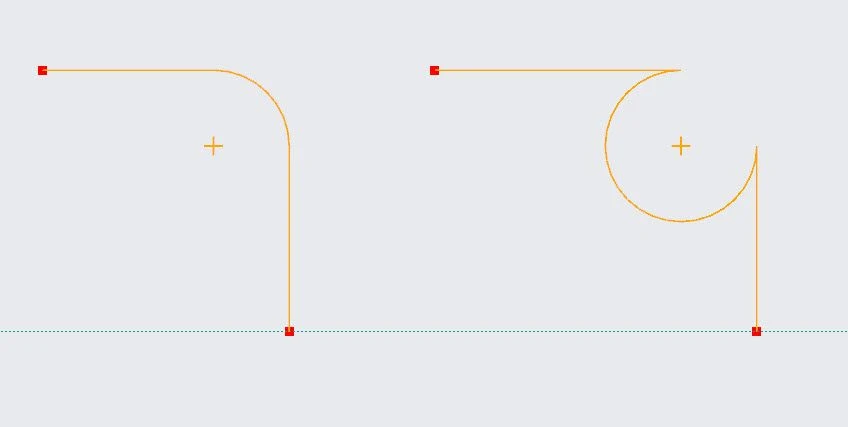
 

Flipping ArcFlipping Arc

12 replies

Jun 15, 2023 3:41 PM UTC

b) is the problem statement really related to (flipping) fillets only or is this for tangency/anti-tangency flipping in general?

  • This is not skech fillet tool only. General.
  • Should you have say 3 arcs sketched, then controlling dimensions / curve flipping gets difficult.

The tangent direction arrow proposed, might also work. Question is how one does it internally (store values of surrounding curve directions, etc)

Mar 3, 2026 1:05 AM UTC

It happens in tangent arcs in general, but in our cases, most of this tangent arcs that we put in the sketch is with the fillet tool, not with manually creating an arc, and after manually applying tangentcy to the lines.


So, the best way to solve this issue (in more than 95% of the cases), is to try to update the fillet (and chamfer) tool inside sketch as a kind of "2D feature" (with a model tree), where the fillets are applied as a "post-processing" operation on sketches that have mostly only linear entities. This would solve the problem when we need to have a parametric sketch with a wide range of values for the angles of the adjacent lines. If we needed to delete the fillet (or chamfer) we could select either on the graphics screen, or on the "2D model tree", where the adjacent lines would automatically trim again themselves (healing).


Besides the fillets (and chamfers), there are other 2D operations that would be helpfull to be put on a "2D model tree", like the project entities, offsets, thickens, mirrors... This would also need for the regular entities (lines, circles, arcs) to also be put inside a "2D model tree" (one for each future "sketch group" in later Creo versions). The goal of this would be to also let the user create parametric patterns inside sketch (which would also appear as a "pattern" inside the "2D model tree"), where the user could double click on the said 2D model tree pattern feature to parametrically change the numer of instances, direction, center (for rotational patterns, etc).


The mirrors being implemented as a "2D feature" inside sketch would also better allow redefinition (add more entities to mirror, change the mirror axis, and allow other options, like mirroring around a point, which currently is not possible).


This "2D features" to define the fillets would also better implement the "Vertex Fillet" that is about to be introduced in Creo 13. But this would allow better implementation, since the vertex would always be the referenced entity, instead in the Creo 13 implementation that will convert the vertex selection on the UI to 2 adjacent lines on the sketch database.


Also, this would also better future implementation of 2D booleans (automatic merging, or subtraction of shapes, as happens in Catia, although in Catia's case, it is only implemented as an acceleration process for the trimming operations, but on the final sketch there is no reference to any "closed shapes" after the one time boolean process. Creo could improve on this, by using the future "Sketch Groups" as a 2D conterpart of the 3D bodies for the 3D boolean operations. Meaning, that the closed shapes could be added or removed on the main sketch on a tree base, and the new "2D Boolean" operation could be added (also on the 2D model tree) to Add, Subtract, Intersect the said closed shapes (or vertex groups) from another higher level Sketch group.