
Global search: Find components with given distance (e.g. "0") in assembly
1. Describe the Problem
We would like to have a functionality in creo to find certain components in assemblies by given distances. The command should sound e.g. like, "Please creo, show me all "floating" objects in my assembly".
While "floating" means a distance of e.g. 0 or 0.1 mm or greater than XY to any next component,
Following picture with a primitive example should be comprehensive:
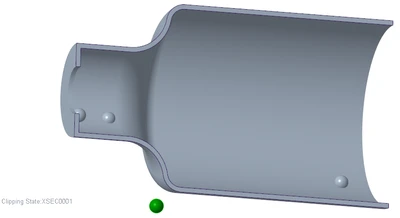
The green component has a distance of greater than 0 to all other components in the assy. All other parts are tangent (coincident) or penetrating the housing.
My idea should reactivate that one:
https://community.ptc.com/t5/Creo-Parametric-Ideas/Improve-the-SEARCH-FIND-tool-to-find-components-with-additional/idi-p/458025
Sadly, the original idea was archived.
2. Are you using a workaround?
As existing functionality does not deliver quick and complete results (Pairs clearance, global clearance, Search tool...), some of our users found a workaround in CCX-module (clearance and creepage extension). With that, it is possible to create electrical nets by selecting components and exclude them later from selection. So, it is a misuse of a quite expensive license for global geometrical distance analysis. And, we need to doublecheck measurements, and in the end combine this with simplified reps and/or similar selection methods. Furthermore, the user has to know every single component in the assembly. This gets difficult with huge assemblies including lots of 3rd-party models. So, our woraround isn´t 100% reliable.
3. What is the use case for your organization?
We could detect all components that are not touching other models. With these models, our thermal and flow simulaition results wouldn´t be corrupted anymore by misleading distance measurements. Manual preparation could be saved.
4. What impact does this problem currently have on your organization?
- Long preparation time, - Wrong simulation results as we can´t detect all areas for fluids in our assemblies, - We have to use a rare, specialized and expensive license for a more or less easy geometrical task.