
Enhanced solid shrinkwrap or copy geom- only outer geometry with optional capped holes
1. Describe your environment: What is your industry? What is your role in your organization? Describe your stakeholders.
I´m resposible for CAD-methodology at an OEM car manufacturer. We´ve more than 500 CAD users.
2. What version of Creo Parametric are you currently running?
creo 7 & 8
3. Describe the problem you are trying to solve. Please include detailed documentation such as screenshots, images or video.
The picture shows an example: The red arrow marks the inner geometry, that must not be part of the surface copy of the whole assembly.
We utilize shrinkwrap functionality for surface copies of huge assemblies. Coworking with internal departments and external supplieres requires certain degrees of detailed information.
In some cases, it is a must to hide inner contures/geometry.
Only outer shell geometry shall be collected.
Inner components have to be excluded from shrinkwrap.
Additional auto hole-filling functionality is also necessary by option. Selection of bounding surfaces shall be quick.
For all ways to create shrinkwrap, the result has to have at least same quality as original data.
Solid original geometry shall result in fully closed shrinkwrap (closed quilts as well).
Result should be similar to a single merged component, coming from an assembly, but no inner geometry.
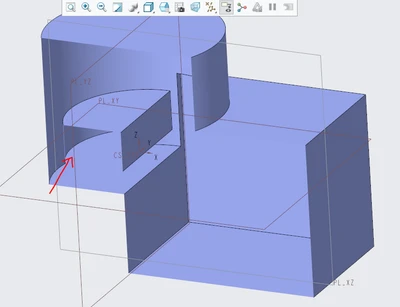
Currently, "Copy geom" functionality is only applicable components. For assemblies: merge and filling holes manually is high effort. No chance in case of assemblies with several houndreds of parts.
4. What is the use case for your organization?
Data exchange with partners and supplierers / further processes in company (simulation, mockup,...).
Know-how protetction
Outer surface copy of whole engine / gearbox assy as a single, lightweight part. No inner geometry shown. Closed volumes without loss of surfaces.
5. What business value would your suggestion represent for your organization?
Huge reduction of manual data collection: faster and easier geometry creation.
Huge reduction of manual data repair time
Know-how-protection: No inner geometry and holes shown
No loss of data (single outer components will be missed compared to manual collection)
Reduction of data size: resuling geometry is less complex than made by current methods