
Oct 15, 2014 12:14 PM UTC
Question

Re: How to calculate uniform load across a surface

Lucky,

The load is not calculated in the attached model. It was predetermined by the user as 2000000 N and entered as such. The hinge acts like two cantilever beams, because the center of the hinge is constrained in global xyz. Even though you have Force/Area, the ends of the beams will bend and have less stress than the center, as shown below. If you want to understand how the load behaves (shear load), try drawing a shear/moment diagram on a beam with one end fixed and the other end free.
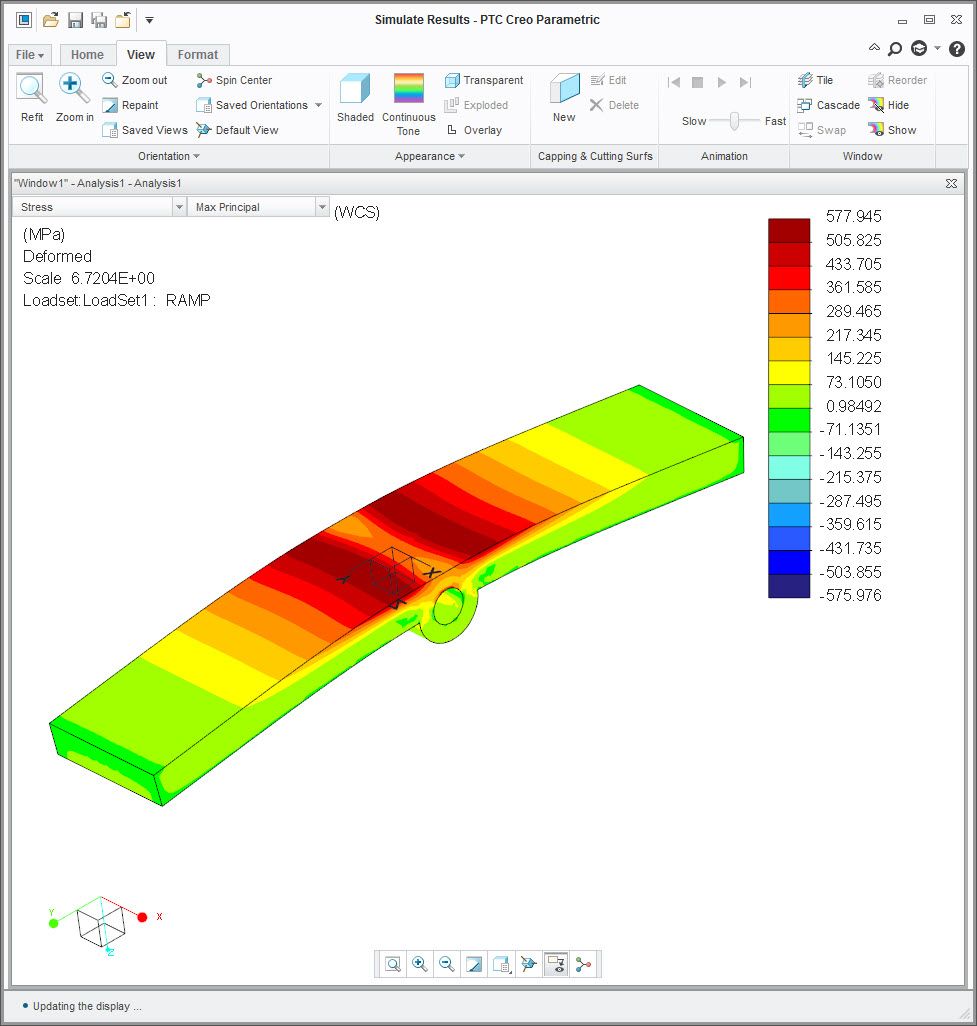
uniform_load.jpg

    3 replies

    Oct 15, 2014 4:33 PM UTC

    Dear Steven,

    Thanks for the prompt response. I really apologise for the misunderstanding caused by my ambiguous discussion title.

    I had kept the load as 2MN for the surface and meant to ask how I can calculate load behaviour across the surface.

    In the part above, I am trying to simulate a load similar to a crate with a rectangular surface having area same as the surface of the ramp. Now if the load was something similar to a car then we can understand that the load would be concentrated on the four contact points of the ramp but here, the load is distributed uniformly across the surface.

    Pardon my ignorance, but I am assuming that surface to surface contact plays a significant role when the load is behaving like a rigid body under normal circumstances (a heavy metal beam, or a dense object which wont bend easily.)

    So in this scenario, how can I best 'calculate the uniform load behaviour across the surface?

    Once again I apologise for the misleading title.

    Oct 16, 2014 1:02 AM UTC

    Stress, strain and displacement calculations.

    If load is just concentrated at 4 points then we can agree that the model above simulates this behaviour correctlly, but what of load that is uniformly distributed across the surface. Wouldn't the contact surface area play a significant role in the stress, strain and displacement calculations of the same?

    Oct 16, 2014 3:54 PM UTC

    Thanks again, Steven.

    I think your answer hits the nail on the head. Funny thing is that I was googling for a solution and came across this term quite a few times.

    I tried looking for learning resources online. If it is not too much of a trouble to you, then can you please list a few starting places (and tutorials for doing FEA with pro engineer as well).

    Regards,

    Lucky